
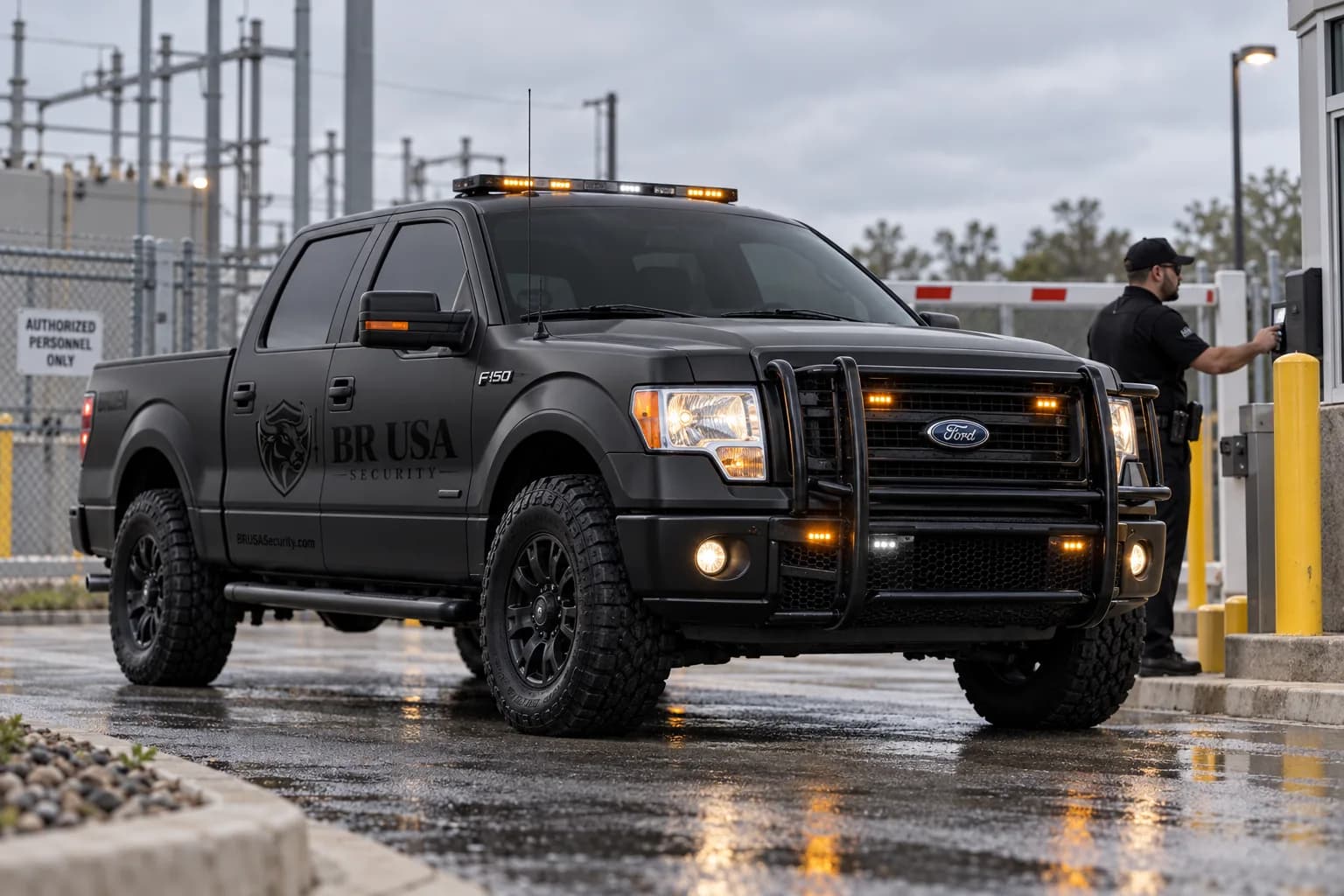
The short answer: Temporary fencing and gates create a physical perimeter that slows intruders, keeps the public away from hazards and funnels authorized people through one controlled entry point. Fences alone get cut, climbed and left open, so they work best paired with a patrol or posted officer who checks the fence line and runs the gate.
A fence says "keep out." A patrol makes sure people listen.
Most of what BR USA Security does is about presence: an officer and a marked vehicle on site, around the clock. But some properties also need a physical line on the ground. Here's when temporary fencing and gates make sense, and why they work best with eyes on them.
When a property needs a physical perimeter
After a fire or storm. Debris, broken glass, unstable walls and open floors are hazards for anyone who wanders in, including kids and curious neighbors. A fence keeps the public at a safe distance and gives the site a single, controlled entrance.
On construction sites. Sites are full of attractive hazards and valuable materials. Construction sites are often unsecured, which leaves them vulnerable to intentionally set fires.[1] A perimeter reduces casual trespass and defines where security begins.
Around vacant buildings. The fire code expects owners of vacant buildings to secure them against unauthorized entry.[2] Fencing helps when the building envelope itself can't be closed, or when the lot invites dumping and loitering.
When access needs managing. Adjusters, contractors, utility crews and tenants all need in. A gate turns "anyone can walk in" into "everyone signs in."
What fencing does well
- Slows people down and removes easy, casual access.
- Defines the boundary so trespass is unambiguous.
- Keeps the public away from hazards.
- Funnels traffic to one gate where it can be checked and logged.
- Signals control, especially when paired with signage naming the security provider.
What fencing can't do
- It can't stop a determined person. Panels get cut, bases get lifted, low sections get climbed.
- It can't close itself. Gates get propped open by crews and left that way overnight.
- It can't report a breach. A cut panel at 1 a.m. stays cut until someone notices.
- It can't tell who belongs. Anyone with a hard hat looks like they work there.
That's why we treat fencing as a supporting layer, not the security plan.
Fencing plus patrol: how it works together
- Fence-line checks every round. The officer walks or drives the perimeter looking for cut ties, lifted bases, gaps and damage.
- One staffed gate. Authorized people enter through a single point; the officer checks the access list and logs entries.
- Gate closed and locked when unstaffed. No propped gates after crews leave.
- Breaches documented and repaired. Photographed, reported and fixed, not ignored.
- Marked vehicle inside the line, visible from the street, so the perimeter looks watched, because it is.
Planning a temporary perimeter: checklist
- ☐ Where are the hazards the public must stay away from?
- ☐ Where will the single controlled gate go?
- ☐ Are fire lanes, hydrants and fire department connections clear and reachable?
- ☐ Has the local fire department weighed in on gate access and locks?
- ☐ Who holds keys or codes, and who is on the authorized list?
- ☐ Is there lighting on the gate and the most vulnerable fence sections?
- ☐ Is signage posted with the security provider's contact information?
- ☐ Who checks the fence line, and how often?
Gate placement deserves extra care. A perimeter that keeps out thieves but slows down a fire engine creates a new problem. Coordinate with your fire department before you fence.
Where this fits in our services
BR USA Security can add temporary fencing and gated access points to emergency, construction and vacant-property assignments as part of one plan. The fence handles the boundary; our officers handle everything a fence can't. For construction sites, see construction site security in Charleston. For damaged properties, see what happens when you call for emergency security.
Need a perimeter and people to watch it? Call (843) 606-0195.
Frequently asked questions
Do I need temporary fencing after a fire?
Often, if the building can't be closed, debris or hazards are exposed, or the public could wander onto the property. Fencing also helps control access during cleanup and repairs.
Is a fence enough to secure a construction site?
Usually not on its own. Fences can be cut, lifted or climbed, and gates get left open. A patrol that checks the perimeter and controls the gate makes the fence effective.
Can temporary fencing block fire department access?
It can if it's poorly planned. Coordinate gate locations, fire lanes, hydrants and key or lock access with the local fire department before installing a perimeter.
Does BR USA Security provide fencing?
Yes, as a secondary service that supports on-site patrol and posted officers. Our core service is the person and vehicle on site.
Sources
- Construction Site Fire Safety fact sheet (NFPA Research, Fires in Structures Under Construction, 2022). NFPA, hosted by City of Salinas Fire Department. Accessed October 3, 2026.
- Vacant Building Fires (M. Ahrens, NFPA). NFPA, hosted by U.S. Department of Housing and Urban Development. Accessed October 3, 2026.