
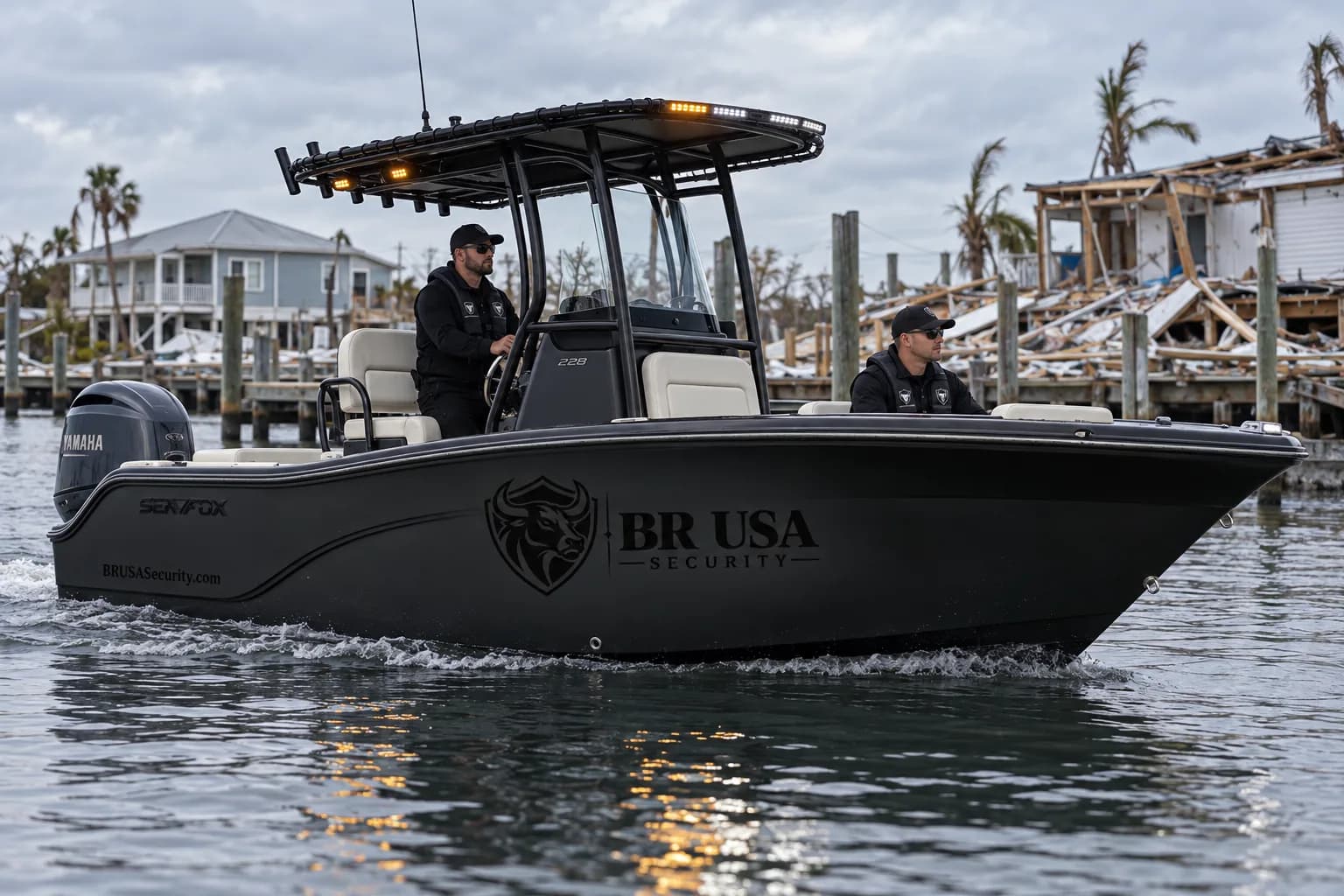
The short answer: After a hurricane, tropical storm or tornado, damaged buildings in the Lowcountry often sit open, without power, alarms or cameras, for days or weeks. Owners should re-enter only when authorities allow, document damage, control access, and put a visible security presence on site until the building can be locked, powered and monitored again.
The storm passes in a night. The damage stays for months.
When the wind dies down across Charleston, owners face the same problem whether the cause was a hurricane, a tropical storm or a sudden tornado: buildings that can't lock, can't power their alarms and can't be occupied, sitting in a city full of people moving around damaged property.
This guide covers how to protect storm-damaged property from the moment it's safe to return.
The Lowcountry's storm reality
Charleston knows storms. Hurricane Hugo made landfall near Sullivan's Island around midnight on September 22, 1989, as a Category 4 hurricane with estimated sustained winds of 135-140 mph and produced record storm tides; the National Weather Service notes that a track slightly farther south would have meant much worse flooding downtown.[1]
It doesn't take a Hugo. In August 2024, Tropical Storm Debby stalled over the Southeast and brought prolonged heavy rain to southeast South Carolina, with widespread flash flooding on August 5-6, river flooding that persisted for days, several nighttime tornadoes across the Lowcountry and outages to power and communications.[2] Debby then made a second landfall near Bulls Bay, between Charleston and Georgetown, early on August 8.[3]
Different storms, same aftermath: open buildings, dead systems and a long repair queue.
Why storm-damaged property is so exposed
The systems go blind. Power outages take down alarms, access control and cameras. Battery backups run out. Internet and cellular links that feed remote monitoring can fail with them.
The building can't close. Blown-out glass, torn roofing, jammed or broken doors and downed fences leave openings that can't be fixed until crews and materials are available.
Everyone is busy. Police and fire are stretched across the whole region. Contractors are booked for weeks. Owners may not be able to get back yet.
Lots of strangers are moving around. Contractors, adjusters, utility crews and volunteers mean an unfamiliar face near your building doesn't look out of place, which also helps people with no business being there.
Phase 1: Safe re-entry
Don't go back until officials allow re-entry in your area and conditions are safe. South Carolina coastal counties announce evacuations by predesignated zones, and SCEMD's Know Your Zone tool shows yours.[4] Watch for downed lines, gas leaks, flood water and structural damage. Security personnel shouldn't ride out dangerous conditions on site either; the goal is fast, safe re-establishment of presence afterward.
Phase 2: Document and stabilize
- Photograph and video every side, every opening and every damaged area before cleanup.
- List equipment and inventory inside; move irreplaceable items if it's safe.
- Notify your insurer and get a claim number.
- Schedule temporary repairs: tarps, board-up, water extraction.
Phase 3: Control access
After a storm, access control matters as much as patrol:
- Write an authorized list: owner reps, adjusters, contractors by company name, and anyone else allowed in.
- Use one entry point where possible, with temporary fencing or a gate if the perimeter is down. See temporary fencing and gates.
- Log every entry and exit: name, company, vehicle, time in and out, and purpose.
- Turn away unsolicited visitors politely and document them.
Phase 4: Put a visible presence on site
A marked security vehicle parked at the property tells everyone driving the area that this building is watched, even when its cameras are dark. An officer on site can also report new damage, water intrusion or a tarp blowing loose before it becomes a bigger claim.
| Condition after the storm | Suggested coverage |
|---|---|
| Building open, no power | 24/7 posted officer |
| Boarded or tarped, no power | Overnight posted officer plus daytime checks |
| Power and alarms restored, repairs ongoing | Overnight patrol checks |
| Repairs complete, building lockable | Hand back |
Phase 5: Plan for a long repair window
After a regional storm, repairs can take far longer than owners expect because the same roofers, glaziers and restoration crews are serving everyone. Plan security for the realistic timeline, not the hopeful one, and scale it down as milestones are met.
Before next season
The owners who recover fastest made their calls before the storm: insurance contacts, a security provider, a board-up vendor and a list of who's authorized on site. Hurricane season runs June 1 through November 30. Put your post-storm security plan in place now.
BR USA Security re-establishes on-site presence at storm-damaged properties across the Charleston area as soon as it's safe, 24/7/365. Call (843) 606-0195 or review our emergency response services.
Frequently asked questions
When should security arrive after a hurricane?
As soon as officials allow re-entry and conditions are safe. Security personnel shouldn't be on site during dangerous storm conditions; the goal is to re-establish presence quickly once it's safe.
Why do cameras and alarms fail after storms?
Storms often knock out power and communications. Battery backups are limited, and systems that rely on internet or cellular connections may go offline, which leaves people as the dependable backup.
Do I need security if my building only flooded?
Often yes. Flooding can force tenants out for weeks, drying equipment gets staged inside, and doors may not seal or lock. Tropical Storm Debby in 2024 showed how much flooding the Lowcountry can see without a major hurricane.
How do I control contractors and visitors after a storm?
Create an authorized-access list, use a single entry point where possible, and have security log every person and vehicle that enters.
Sources
- Hurricane Hugo, September 21-22, 1989. National Weather Service, Charleston SC. Accessed October 3, 2026.
- Post Tropical Cyclone Report: Tropical Storm Debby (Aug. 4-9, 2024). National Weather Service, Charleston SC. Accessed October 3, 2026.
- Tropical Storm Debby 2024. National Weather Service, Wilmington NC. Accessed October 3, 2026.
- Know Your Zone. South Carolina Emergency Management Division. Accessed October 3, 2026.